INTEGRATION OF CHARGING STATIONS INTO THE COMPANY NETWORK
Dear Sir or Madam,
Should it be necessary to connect your charging systems online via Ethernet rather than mobile networks or similar, or should advanced load management be required, this document is intended to serve as a guide for your IT department.
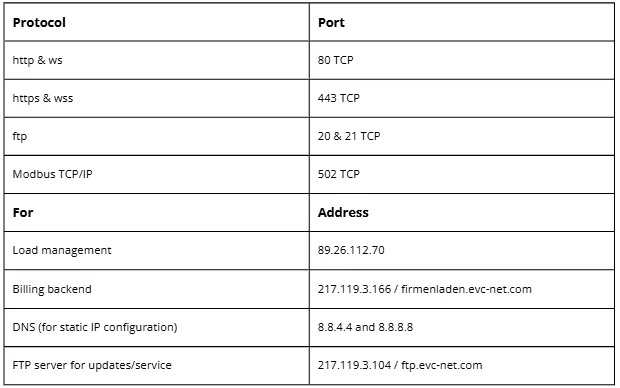
The charging stations usually communicate with the billing backend via an HTTP or WebSocket connection. This connection is necessary to transfer billing-related data for charging sessions to our backend and to bill the relevant users. A connection is also required for our support team to execute remote commands on the charging stations via the backend, e.g. to start a charging session. Furthermore, firmware updates can be carried out via an FTP server, and the charging station’s settings can be adjusted remotely in the event of changes.
For this purpose, specific network ports are required for traffic from internal to external networks and vice versa, which we are happy to provide. You will also find the direct IP addresses or domains of the two endpoints in the table, so that you can restrict access to these two addresses. An NTP server is helpful where possible. For static IP addresses, the DNS servers 8.8.4.4 and 8.8.8.8 are set as the default in the wallboxes and are mandatory. The connection is always established from the internal network (charging station) to the external network (billing backend/load management server).
Authentication via IEEE 802.1X must be checked depending on the charging hardware and cannot be answered in general terms.
An Ethernet connection is also required to transmit power specifications from a load management system to the relevant charging points. In this case, communication between the devices is implemented via Modbus TCP/IP. An example of such a setup is shown in Figure 2 below.